
Are you still doing Christmas shopping for others and for yourself? Now you can do good and save money at the same time (I love that combination). I just learned that Banana Republic and Goodwill have teamed up for a special--bring in a gently used sweater to BR from 12/6 to 12/12 (next Wednesday) and you can get 30% off BR merchandise, excluding 100% cashmere items. The sweaters you give will be sold in Goodwill stores.
I'm seriously behind on my Christmas shopping...chalk it up to poor planning this year. Things are just not as easy to schedule when you're working long hours. Makes for an interesting write-up on shopping strategy, though.
Showing posts with label Goody Two-shoes. Show all posts
Showing posts with label Goody Two-shoes. Show all posts
12.08.2007

11.15.2006
Good Works (Part 5): Cleansing Essentials
OK, part 4 was the fake ending. This is the real one. Stacie, thank you so much for bringing up the shampoos and soaps...I can't believe I was writing about the drive and didn't go into it. In the aforementioned drive for battered women's shelters, some of the donations requested were soap, shampoos, conditioner, toothpaste, lotions, and clothing for the children the women bring along with them. Here's what Stacie said about toiletries she collected:
Oh, here's another thing. I had a yard sale a couple years ago and was getting rid of a small box of hotel soaps and shampoos I had collected. Someone told me that the local battered women's shelter would take stuff like that. I always send away for a lot of free samples that I never end up using which they would probably accept as well. Also, I had a whole box of new boxes of toothpaste, soap, and shampoo which I had been getting for free at the grocery store with doubled coupons. My mom gave a whole bunch of that away to Hurricane Katrina victims when there was a call to donate. I usually give a bunch of it away every year during the Postal Service Food drive.
That's why my readers rock =)
Good Works (Part 4): Let Old Glossies Shine
Here's the last post of my charitable givings series, and it's a pretty short one (thank goodness, right?). I'm sure that most people subscribe to magazines, and if you subscribe to weeklies, there's the problem of what to do with all the issues that starts to pile up. At the minimum, they should be recycled, but there are places that can make more use of them than the recycling plant.
The obvious place is a school or public library. Public libraries can always use a second copy of something they already have, and if they don't want to use it, they can sell it for a dime or a quarter to make some chump change. Sometimes school libraries appreciate them as well. However, there are places least expected that really need them. Last year my school had a clothing/sundries drive for battered women shelters; during the course of that, I was surprised to learn that one of the things these shelters need is reading materials. I also learned during my jury duty that the courthouse wants new reading materials for the jury room.
Donating reading materials is not exactly a popular way of giving, since the logistics is more involved than simply giving money, canned goods, or clothing, but it's something to consider nonetheless. Lest any of the institutions think you're crazy and trying to foist junk upon them, call ahead to see if the donations are needed. If accepted, cut out your address from the cover. Blacking out with a marker just doesn't work well enough because people can still see through.
Since I'm rushing to get things done the rest of this week, I won't be posting again until next Wednesday at the earliest. I'll probably review any sales that I choose to check out, and then I'll talk about my bag lining project.
The obvious place is a school or public library. Public libraries can always use a second copy of something they already have, and if they don't want to use it, they can sell it for a dime or a quarter to make some chump change. Sometimes school libraries appreciate them as well. However, there are places least expected that really need them. Last year my school had a clothing/sundries drive for battered women shelters; during the course of that, I was surprised to learn that one of the things these shelters need is reading materials. I also learned during my jury duty that the courthouse wants new reading materials for the jury room.
Donating reading materials is not exactly a popular way of giving, since the logistics is more involved than simply giving money, canned goods, or clothing, but it's something to consider nonetheless. Lest any of the institutions think you're crazy and trying to foist junk upon them, call ahead to see if the donations are needed. If accepted, cut out your address from the cover. Blacking out with a marker just doesn't work well enough because people can still see through.
Since I'm rushing to get things done the rest of this week, I won't be posting again until next Wednesday at the earliest. I'll probably review any sales that I choose to check out, and then I'll talk about my bag lining project.
11.13.2006
Good Works (Part 3): Lend Your Talents
If you can't afford to give money to a cause but still want to help out, one option to consider is volunteering. Sometimes you get to help those in need directly, and sometimes indirectly through behind-the-scenes functions such as fundraising. When it comes to fundraising events, volunteers are needed to staff ticket sales and food service, to name a few. It can be quite a tedious and thankless chore, as people may snap at you to do this and that. In the end, it will help out a lot, though it doesn't necessarily feel rewarding (believe me, I've been there quite a few times). However, some of the perks include free food or at least free admission, and maybe you might get to scoop up some free leftover goodie bags. If you want something more substantive, you gotta work it. Make it your opportunity to learn a few things and meet some people. I've done a little bit of networking that way. I usually hate networking, but when you're working together, you share something in common. It's a good start for conversations and such.
If doing grunt work is not for you, make yourself part of the attraction. If you love being in the spotlight, consider performing at an event. You'll get the above perks without feeling like you're being ordered around. Even though dealing with the event planning bureaucracy can be a bit annoying, winning the adoration of the crowd at the end of the performance is very rewarding, not to mention all the money you've helped raised. If you're artistic and crafty, create something to donate for an auction. The costs on your part varies, depending on materials and time, but you'll be doing what you love, and best of all, your work may fetch a lot of money. Whether you're performing or crafting, your work will help get your name out there, thereby creating some potential brand recognition. It's virtually free publicity, and any publicity is valuable, especially for a start-up.
That said, even though you're doing something for cheap or for free, put in a professional effort. Don't act or make your product look like crap. Make sure both the quality of the thing itself and its presentation are as high as can be. Packaging is important as a matter of general principles (this goes for gifts you give to your family and friends, especially with the winter holidays coming up and all), but a professional appearance can be achieved with minimal cost. Take this necklace I made as an example:
If doing grunt work is not for you, make yourself part of the attraction. If you love being in the spotlight, consider performing at an event. You'll get the above perks without feeling like you're being ordered around. Even though dealing with the event planning bureaucracy can be a bit annoying, winning the adoration of the crowd at the end of the performance is very rewarding, not to mention all the money you've helped raised. If you're artistic and crafty, create something to donate for an auction. The costs on your part varies, depending on materials and time, but you'll be doing what you love, and best of all, your work may fetch a lot of money. Whether you're performing or crafting, your work will help get your name out there, thereby creating some potential brand recognition. It's virtually free publicity, and any publicity is valuable, especially for a start-up.
That said, even though you're doing something for cheap or for free, put in a professional effort. Don't act or make your product look like crap. Make sure both the quality of the thing itself and its presentation are as high as can be. Packaging is important as a matter of general principles (this goes for gifts you give to your family and friends, especially with the winter holidays coming up and all), but a professional appearance can be achieved with minimal cost. Take this necklace I made as an example:
 Until now, I only made things for myself and people I know on a casual basis, so I never bothered to package jewelry. However, when I decided to design a piece for an auction, I had to worry about packaging. I actually spent a lot of time looking all over the place for creative yet inexpensive ways of packaging things. In the end, I ended up using a free-with-purchase box that I got from FIDM and some tag board that I bought to make exhibits with for my trial class. The board functions as a little raised platform on which the necklace is pinned down and displayed. The yellow plastic box alone looks incredibly cheapy, but add some creative arrangement and you've got yourself something marketable.
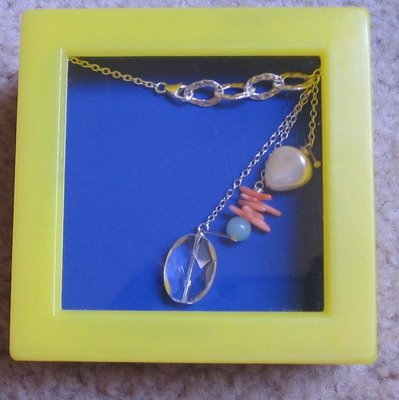
This is certainly not the best example. If I had more time, I would have done a better job. Weeks later, I went to the Container Store and found some sleek yet affordable boxes.
11.07.2006
Good Works (Part 2): In the Can
Man, it's been an exhausting day. Just wanted to unwind a little bit before doing tomorrow's reading...coffee ain't helping me stay awake. Watch that by 4am, I'd be too jittery to get any sleep.
Anyway, back on track with the charitable giving series. It's November, so you know what that means--food banks are especially in need of canned goods for the holiday seasons. They need food all year round, but the holiday period is significant for obvious reasons. It's sad that most people don't do anything to help out until now, but if nothing else, give families that are less fortunate a chance to have some holiday cheer. Some people may be apathetic about giving, thinking that food banks only help some drug-addict bum who just won't get a job, or some welfare mom looking to freeload. It may surprise you that a large number of families, including people you might know, don't have enough to eat. Sometimes even grad students need welfare or foodstamps. People who work hard at their jobs can barely make enough to feed their families. I'm not exaggerating--I've seen a lot of things through some volunteering gigs and I also personally know people in this situation.
Traditionally, supermarkets are the biggest donors because they often have overstocked goods. However, because of modern technology, stores are much more efficient with their inventory and hence there's less overstocked items, which in turn lowers the amount of donations going to food banks. Hence, it is more important than ever for individual citizens to do their part. Being a (educational) debt-ridden student, I can't afford to give much cash, but canned goods donation is a small way through which I can help out. It's virtually painless--everyone is bound to have something in their pantry that's been there for a while. It's probably going to continue to sit there, so why not get rid of it? Sometimes donating cans will get you a little something in return. Some business will offer a token gift (like a coupon) to customers that donate cans.
If you're in a leadership position, you can rally people to action. If you're able to give a small perk, you can really generate a tremendous response. In the same class where we generated huge donations for Hurricane Katrina relief efforts, the professor got a load of canned goods donated. He made us a deal: if each person (in a class of 125) brings in 2 cans, he won't call on anyone in class for a day. Since it was a fairly difficult class, no one wanted to get called on. He allowed people to bring extra to cover for those who forgot. He instituted one rule: no cheap stuff. He was going to inspect each can and make fun of people who brought in some strange crap.
Peer pressure certainly worked; who wants to be the one that blew it for the entire class? Some people brought in lots of cans to cover for the absentminded; I remember seeing several pyramids throughout the classroom. Sadly, some people did bring in crap, but their public humiliation by the professor (who read the labels out loud to the entire class) was quite entertaining; I'm laughing about it as we speak.
The point is, it doesn't take a lot to make a difference, so just make that small effort. If you think "well, I'm just one person, so they're not missing out on much," imagine what happens when everyone thinks the same way. 2 cans a person can lead to hudreds of cans if enough people get involved, and that makes a huge difference. It's the cheapest way to solve a social problem and feel good about yourself at the same time...even better than retail therapy.
Anyway, back on track with the charitable giving series. It's November, so you know what that means--food banks are especially in need of canned goods for the holiday seasons. They need food all year round, but the holiday period is significant for obvious reasons. It's sad that most people don't do anything to help out until now, but if nothing else, give families that are less fortunate a chance to have some holiday cheer. Some people may be apathetic about giving, thinking that food banks only help some drug-addict bum who just won't get a job, or some welfare mom looking to freeload. It may surprise you that a large number of families, including people you might know, don't have enough to eat. Sometimes even grad students need welfare or foodstamps. People who work hard at their jobs can barely make enough to feed their families. I'm not exaggerating--I've seen a lot of things through some volunteering gigs and I also personally know people in this situation.
Traditionally, supermarkets are the biggest donors because they often have overstocked goods. However, because of modern technology, stores are much more efficient with their inventory and hence there's less overstocked items, which in turn lowers the amount of donations going to food banks. Hence, it is more important than ever for individual citizens to do their part. Being a (educational) debt-ridden student, I can't afford to give much cash, but canned goods donation is a small way through which I can help out. It's virtually painless--everyone is bound to have something in their pantry that's been there for a while. It's probably going to continue to sit there, so why not get rid of it? Sometimes donating cans will get you a little something in return. Some business will offer a token gift (like a coupon) to customers that donate cans.
If you're in a leadership position, you can rally people to action. If you're able to give a small perk, you can really generate a tremendous response. In the same class where we generated huge donations for Hurricane Katrina relief efforts, the professor got a load of canned goods donated. He made us a deal: if each person (in a class of 125) brings in 2 cans, he won't call on anyone in class for a day. Since it was a fairly difficult class, no one wanted to get called on. He allowed people to bring extra to cover for those who forgot. He instituted one rule: no cheap stuff. He was going to inspect each can and make fun of people who brought in some strange crap.
Peer pressure certainly worked; who wants to be the one that blew it for the entire class? Some people brought in lots of cans to cover for the absentminded; I remember seeing several pyramids throughout the classroom. Sadly, some people did bring in crap, but their public humiliation by the professor (who read the labels out loud to the entire class) was quite entertaining; I'm laughing about it as we speak.
The point is, it doesn't take a lot to make a difference, so just make that small effort. If you think "well, I'm just one person, so they're not missing out on much," imagine what happens when everyone thinks the same way. 2 cans a person can lead to hudreds of cans if enough people get involved, and that makes a huge difference. It's the cheapest way to solve a social problem and feel good about yourself at the same time...even better than retail therapy.
10.25.2006
Good Works (Part 1): Tiny Jury Fee, Absolutely Simple Choice
Wow, I am surprisingly prolific in terms of blogging this week. I guess I'm a bit lazy because I'm taking a de facto break after of all the hustling I had to do these last 2 weeks for school stuff. Still, my jury duty has turned this week into a topsy-turvy. I have to go back at the end of the week, which means no sample sale shopping. Bummers. At least I think I get my 15 bucks plus mileage for the second day of service...which leads me to the beginning of yet another series.
I strongly believe that we should all give back to the community because we owe our successes to community support. Since I don't have much by the way of monetary assets, I try to stretch what little I have into as big a gift as possible. You may recall how my class managed to raise a load of money for Hurricane Katrina relief; if not, here's the story. In this new series, I'll talk about more ways you can make a big impact without spending much money. In some cases, it's not about the money. It's about other supplies. It's the thought that counts.
Back to today's topic: jury fees. You certainly can't count on jury service to get you a quick buck. I don't know how it works in other parts of the country (or other counties for that matter), but L.A. County has a system where jurors don't get paid for the first day of service, but they do get paid $15 plus mileage for subsequent days of service. Curiously enough, government employees would only get mileage, not the $15. I can use that $15, and I do need the money, but for those of you who are government employees who end up with really nominal (think in the pennies) fees, you might want to consider donating your fees.
It costs more for the government to send you a check than the check is worth, then it takes more gas money to get to the bank to deposit the check...kinda silly, huh? All that money spent just so that you can have your 50 cents--if that's not waste, I don't know what is. So why not just let those few cents and dollars go to a good cause? The court I was at runs several programs, including one for abused and neglected kids. If each person donate their nominal fees, it would help out. For "civilians" who are well off enough not to need the $15, or those who get paid by their employers for their jury service anyway, consider donating that money to any cause of your choosing (not limited to the court-affiliated ones, I mean). It may seem like chump change for you, but $15 can buy a lot of things.
[As a bonus for my fellow law nerds: caught my bad joke of the day buried in the title? Sorry, I picked up the bad habit from a couple of profs. Gotta give them props for at least trying to make the UCC and Lanham Act fun.]
I strongly believe that we should all give back to the community because we owe our successes to community support. Since I don't have much by the way of monetary assets, I try to stretch what little I have into as big a gift as possible. You may recall how my class managed to raise a load of money for Hurricane Katrina relief; if not, here's the story. In this new series, I'll talk about more ways you can make a big impact without spending much money. In some cases, it's not about the money. It's about other supplies. It's the thought that counts.
Back to today's topic: jury fees. You certainly can't count on jury service to get you a quick buck. I don't know how it works in other parts of the country (or other counties for that matter), but L.A. County has a system where jurors don't get paid for the first day of service, but they do get paid $15 plus mileage for subsequent days of service. Curiously enough, government employees would only get mileage, not the $15. I can use that $15, and I do need the money, but for those of you who are government employees who end up with really nominal (think in the pennies) fees, you might want to consider donating your fees.
It costs more for the government to send you a check than the check is worth, then it takes more gas money to get to the bank to deposit the check...kinda silly, huh? All that money spent just so that you can have your 50 cents--if that's not waste, I don't know what is. So why not just let those few cents and dollars go to a good cause? The court I was at runs several programs, including one for abused and neglected kids. If each person donate their nominal fees, it would help out. For "civilians" who are well off enough not to need the $15, or those who get paid by their employers for their jury service anyway, consider donating that money to any cause of your choosing (not limited to the court-affiliated ones, I mean). It may seem like chump change for you, but $15 can buy a lot of things.
[As a bonus for my fellow law nerds: caught my bad joke of the day buried in the title? Sorry, I picked up the bad habit from a couple of profs. Gotta give them props for at least trying to make the UCC and Lanham Act fun.]
9.23.2005
How to maximize your generosity
Instead of blowing your bargain savings on another shopping trip, think of people who have no money to buy even the most basic of necessities. Donating your money to fellow human beings is the best use for your money. Not only do you feel good about it, it really does help people get back on their feet.
Getting the bang for your buck is great for your stuff, but it is just as important when it comes to charity. One way to maximize your donation is to look for groups that are willing to match. You'll be surprised by how far it'll go. For example, I was trying to decide how much to give and which charity to donate to when one of my professors gave us a challenge: he wanted us to each bring in $2 for a goal of raising $250 total. In turn, he would match it and then bring it to a place that was willing to match as well. The response turned out to be overwhelming: I could only afford to give a humble $5 (which eventually turns into $20, if you do the math), and some others gave $30 and even $125. The class (of around 100 people) raised a whopping $1,152! The prof matched it and brought it to the place that would match and donate all the money to the Red Cross. At first, the person there thought the prof collected it from his colleagues, but she was stunned to learn that it all came from us debt-ridden students.
If you find old clothes squeezing your new bargain finds out of your closet, or see old appliances lying around, consider cleaning them out. Many schools and community groups are accepting donations of clothing or practically anything else. One of my classmates has family in New Orleans, and many of her relatives have absolutely nothing, so she organized a drive that takes anything and everything. Things like extra school supplies or desk lamps will go a long way for many people. Even if the drives in your community have ended, Thanksgiving is coming up, so keep that in mind.
And if time is money, you can certainly give that as well. If you're in a major metro area, chances are evacuees are in your area. Your local Red Cross might have shelters serving them, and I'm sure they'll appreciate help serving food. If you have special professional skills (or training for them), I know that various law schools and medical schools are organizing free clinics. For example, Public Counsel, one of the country's biggest pro bono firms, is training lawyers and law students to help fill out forms for public assistance and provide other legal services to those who need them.
Last but not least, please don't limit your generosity to times of crisis. Situations like this had been years in the making, and it's important for us to help resolve social issues before they snowball into a catastrophe. Hopefully the good feeling you get from opening your hearts now will inspire you to continue doing good. I know it sounds like a cliche, but believe me, it really does make a difference in the long run.
Getting the bang for your buck is great for your stuff, but it is just as important when it comes to charity. One way to maximize your donation is to look for groups that are willing to match. You'll be surprised by how far it'll go. For example, I was trying to decide how much to give and which charity to donate to when one of my professors gave us a challenge: he wanted us to each bring in $2 for a goal of raising $250 total. In turn, he would match it and then bring it to a place that was willing to match as well. The response turned out to be overwhelming: I could only afford to give a humble $5 (which eventually turns into $20, if you do the math), and some others gave $30 and even $125. The class (of around 100 people) raised a whopping $1,152! The prof matched it and brought it to the place that would match and donate all the money to the Red Cross. At first, the person there thought the prof collected it from his colleagues, but she was stunned to learn that it all came from us debt-ridden students.
If you find old clothes squeezing your new bargain finds out of your closet, or see old appliances lying around, consider cleaning them out. Many schools and community groups are accepting donations of clothing or practically anything else. One of my classmates has family in New Orleans, and many of her relatives have absolutely nothing, so she organized a drive that takes anything and everything. Things like extra school supplies or desk lamps will go a long way for many people. Even if the drives in your community have ended, Thanksgiving is coming up, so keep that in mind.
And if time is money, you can certainly give that as well. If you're in a major metro area, chances are evacuees are in your area. Your local Red Cross might have shelters serving them, and I'm sure they'll appreciate help serving food. If you have special professional skills (or training for them), I know that various law schools and medical schools are organizing free clinics. For example, Public Counsel, one of the country's biggest pro bono firms, is training lawyers and law students to help fill out forms for public assistance and provide other legal services to those who need them.
Last but not least, please don't limit your generosity to times of crisis. Situations like this had been years in the making, and it's important for us to help resolve social issues before they snowball into a catastrophe. Hopefully the good feeling you get from opening your hearts now will inspire you to continue doing good. I know it sounds like a cliche, but believe me, it really does make a difference in the long run.
Subscribe to:
Posts (Atom)