Showing posts with label Clothing Care. Show all posts

4.27.2008

Spring Cleaning...

Since I made some good progress on a memo I'm working on, I feel that it's an appropriate time to procrastinate.

Hello again, folks. Things have been quite busy, as I've been traveling back and forth and working 7 days a week. Before the barrage of work, I managed to do something that I've been wanting to do for quite some time--reorganizing my closet space. I'm sure that most women who live in an apartment in the city can relate to the closet issues I'm having. As I accumulate more and more clothing, it became harder and harder to find things. And if I can't find them, I end up wearing them less and less, which means the cost-per-wear ratio is not going in the direction I would like. Like they say, out of sight, out of mind--this holds true no matter how much I love those forsaken articles of clothing. Hence, I wanted to find a way to make sure I see the whole collection.

I didn't take a "before" photograph of the whole closet, so I'll have to paint some of the picture in words. I have a fair amount of space in my walk-in closet, which is basically one small room with hanger poles on 3 of the walls and a wooden plank right above it. Unfortunately, it is difficult to access the portion behind the door, which is 1/3 of the closet. Therefore, I store the less frequently worn items (such as outerwear, ski gear, and special occasion tops and dresses) in those spaces. In the more accessible areas, I hang the things that wrinkle easily, and things I wear the most often or need in a hurry, things like hoodies, work tops, and suits.

As for the shelves above the hanging poles, I stored shoes, miscellenous items (such as scarves and socks) in tupperware, towels, and bedding. The latter two categories are stowed away in Sterlite plastic drawers, which are weighed down by books. I chose the drawers because I wanted to reach things easily without having to remove stacks and stacks of whatnot from above. I like to think that I'm using those shelf spaces pretty wisely.


Right below the hanging poles and all that dangling fabric, I had a laundry hamper by the door, then a plastic 3-drawer cart to the left of that, followed 2 suitcases against the wall, and a pile of junk in the dead-center of the closet. The suitcases contain items that are not suitable for the current weather, or just things that I no longer wear but want to hang onto for whatever reason. That usage is fine, but clearly, I was not making the most efficient use of that dead-center space. I can't believe I allowed prime real estate to be populated by junk.

In between the accessible and less-accessible areas, I hung a couple of those wrap-around-the-pole-and-hang-down canvas sweater shelf-thingies, along with a couple of those wrap-around-the-pole-and-hang-down canvas shoe-holders.

One of those said sweater shelf-thingies held jeans and some of my purses, while the other held t-shirts and sweaters that were fairly low maintenance. Unfortunately, the shelf-things sagged with weight over time, and being jam-packed with clothing with little room to expand, a lot of my clothes became buried, wrinkled, and hidden. It became a chore to shove clothes into the shelves, and it was even more difficult to pull things out of them. Alas, I didn't have the time to worry about sorting it out, and much less the money on organizing tools. Those Sterlite drawers came from Big Lots, but they weren't exactly cheap, so I couldn't just go out and get a bunch of them.

Things came to a head about a month or so ago. Since I don't have much time these days and I'm sick of finding presentable clothes for work, I decided that it was time to do a closet overhaul. I knew that I needed to chuck those hanging sweater-holders and get some drawers, which would enable me to store clothes more neatly and reach them more quickly. I also knew that the drawers had to have wheels for mobility, because from time to time I need to reach the suitcases.

Besides being fed up with the situation, it was the perfect time to do an overhaul because Target was having a sale on the plastic drawers that I needed. On top of that, my mom had a coupon for some percentage (or dollars) off for purchases over $25, which was sent out in the mail in an effort to coax customers to a newly-opened Target. I took that coupon and went to that newly-opened Target, and apparently there was a lot of like-minded customers who wanted to reorganize their homes--many of shelves of organizing containers were cleaned out. I ended up snagging a lavendar-colored set of drawers from the children's section for about $25. I also picked up some hangers. A few days later, I snagged a sturdy white 2-drawer cart (on sale, of course) from another Target. When I got home, I happily took down one of the hanging holders and reorganized away--out went the clothes I no longer wore, and the remainder settled into the drawers. I moved the laundry basket to a different location and moved the drawer carts around to find the best fit. The shoes stayed in place.

By the time I was done, my closet felt so much more open. There was a lot more hanging space next to the shoes (that's where the hanging shelves used to be), and I could actually find clothes easily in the drawers. The prime real estate is now taken up by the 2-drawer cart instead of jumk. It wasn't planned, but it was also nice to have color-coordinated drawer carts.


But I wasn't quite done. There was still the issue of the hanging shelf-thingie that held the jeans and bags. The jeans are quite heavy, and a cart would not have been able to hold everything, so I got one of those ubiquitous wire cube organizers. It was a royal pain to assemble the whole thing, and when I was finished, I realized that there isn't enough space for the whole set-up. So I only kept a 3-shelf tower and stuck it into the closet. Fortunately, it worked out very nicely--the wire racks were sturdy enough to hold the jeans, and roomy enough for me to stick my purses into.


For now, I can live with this. There is still much work to be done. Some of the clothes inside the suitcases really need to go, but that can wait a little longer. And then there's the matter of the over-the-door hangers. The one behind the closet door is fine...


...but check out the one behind my bedroom door.


I'll have to wash the scarves and put them away in some tupperware. That's where they used to belong.

I cleaned out a large portion of the closet just in time. In the following weeks (yes, that's plural), I went out and "restocked." More on that next time. The restocking is more fun to talk about anyway.

6.07.2007

UV = ultraviolent

Summer is here, and so are the many people hitting the beach in bikinis. Even the landlocked have their day by the pool, or in shorts, summer tops, or flirty little skirts. Don't forget to put on sunblock! UV is really bad for the skin.

This is certainly not the case of "what doesn't kill us can only make us stronger," but "what doesn't kill us can make our lives better," with one important caveat--that we harness the force safely. Solar panels have been in use for years as a source of energy. The initial setup isn't cheap, but over time, the savings can be phenomenal. Other than solar-powered calculators, most of us don't have the luxury of enjoying this technology, but there's another use for solar rays that cost us absolutely nothing.

The very thing that kills our skin cells can also be used as a disinfectant of sorts.

Think about it--UV is used to irradiate things all the time. It works by frying the DNA of nasty little critters. Obviously, it's a bad idea to stick ourselves under the sun, but I think it can be a good way of disinfecting thrifted items. If the items can be washed, sunning it a good additional step. If the items can't be washed at all (like shoes and decorative items) but you're weary of the germs, why not stick it under the sun for a while? As long the material won't crack or fade under the heat or light, it should be a viable option. If cracking and fading is a possibility, either avoid this method or keep the cooking time short.

I remember my mom used to tell me to let used books sit in the sun for a while. I thought it was a silly idea and didn't do it, but now I've come to realize why it's a good idea. I don't like to do something simply because everyone does it--just because people it's a routine practice doesn't make it right. However, many conventional wisdoms, ancient practices, and traditional therapies do have an underlying scientific/logical reasons to justify them. It's just that the practitioners are way before their time and haven't found a "why." If I can see a rational basis for a particular method's effectiveness, I'd be happy to consider it. It's just more intellectually satisfying than "because I said so."

Just to be clear, UV is not the end all and be all. It won't kill everything, but it's a chemical-free and hassle-free way of cleaning. Lysol and possibly alcohol are still needed to reach the deep dark corners of shoes that can't be reached by sunlight.

11.03.2006

Once and Future Blues

My wardrobe used to be in want of color. It seemed like the only colors I had were blue, black, and various shades of greys and browns. Then I got adventurous and bought a lot of clothes in all kinds of wild and crazy colors. Now it seems like I'm going back to my roots.


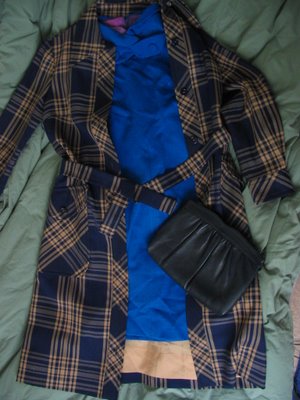
All three items were purchased from the Goodwill, but on separate days. The coat and the bag were acquired on the same trip. I bought the dress a couple of days ago on a side trip after getting gas (it was only a block away).

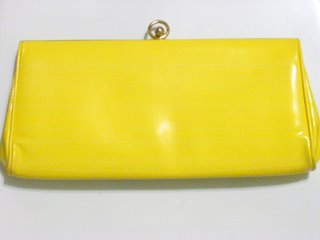
I've been using the bag almost everyday. It really is one of those bags that can be used anytime--weekday, workday, schoolday, and weekends. It's incredibly soft and holds a surprising amount of stuff for a clutch, probably because the pleats and the flexible faux-leather fabric accomodate expansion. Because I carry a backpack, I don't like to mess with a separate purse. When I need to run errands on or near campus, I don't want to haul all my stuff around. Hence, I put my purse, cell phone, keys, etc. in the clutch and toss it in my backpack. Even though it sounds like cruel and unusual punishment for such a beautiful accessory, trust me when I say that it gets to see a lot of daylight. It is so versatile and cheap (only $3)! The cost-per-use ratio is going to be so low by the time this bag finally expires (which I hope won't be anytime close).

As an aside, one caveat about disinfecting vintage bags. I decided to spray the inside and outside with ethanol, per my usual practice, but colors were coming off! I tried to even out the splotches where color came off by wiping down the surrounding areas with ethanol; I figure that doing so would help the splotches "blend in" a little more. It worked out as a mitigating measure. What I should have done was to test a corner for color-fastness. If alcohol or other organic solvents take color off, the better idea is to wipe with mild soap and water, and spray the inside with a disinfectant spray if you want to be extra-cautious.

The dress, the dress, the dress. I absolutely love the color and the collar detail on the dress. What's even better is that the store happened to have a sale on dresses. I got this for $4 instead of the usual $6.99--score! Too bad it wrinkles easily. I tried ironing it while it was still a little damp from the wash, but maybe I should have ironed while it was more wet.

As you can see, I've been on a kick for vintage pieces. Often times they're made better than what we have today, and in my case, they fit a lot better too. I don't like to look like I've stepped out of a time machine. Rather, I like to mix them in with modern pieces. If I were going out on my leisurely time, I could wear the dress exactly how you see it above (with a long-sleeve tee and tights), and with a cute pair of shoes. That look might be a little too cute for my age, however. Since I wore this dress to school, I wanted to look a little more mature and didn't want to be ridiculed for looking like I'm an "Austin Powers" extra. Besides, I wanted to have a bit of a tough chick look anyway. So, I wore a pair of knee-high boot and a loose denim jacket.

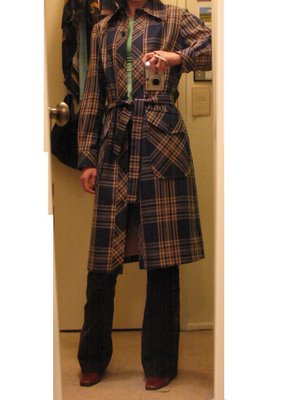
The coat is the most expensive item I've gotten from a thrift store so far. Usually the coats look really ratty and I'm aghast at the audacity to charge $10 for them. Hence, I usually don't even bother looking at the coats, but the one I bought is an exception. It was stuck onto the blazer rack, so the length stood out. I've always wanted a 3/4 length light coat with a pattern on it. The weight and length are perfect for Southern California Autumn weather. All I've been wearing lately is my black hooded sweater coat, and sometimes my denim trench--both of them are in solid colors, so I wanted something different to keep me warm.

I'm guessing the coat is from the early 70's. I found the pattern to be very refreshing--I've never been all that into plaid, even though red tartan seems to be all the rage these days, but the blue and gold pattern is different yet classic. On top of that, the coat is in remarkably good shape. Even though it's polyester, there's absolutely no pilling at all. The inside is lined, and the whole coat is very clean. The tag indicated that it's at least 4 sizes bigger than me, even accounting for the smaller vintage sizing, but as you can see below, it seems to fit just fine when I tie the sash. Overall, this piece has the sillouette of the modern, streamlined look that I like when I feel like dressing up, but the "pop" from the print and colors exudes more personality.


I threw the coat over a green tee, a pair of casual but fitted pants, and a pair of boots. Instantly I felt dressed up. That's why I love 3/4 length outerwear.

9.09.2006

Yellow Pearl

Behold this beauty:


I nabbed this gem of a vintage clutch at the Goodwill for $2. It didn't look this squeaky clean when I bought it. In fact, it was marred by lots of marks, including a very prominent black streak. However, I figured that since the surface is vinyl, I can wash most of it off with soap and water, then take care of the rest of it with a relatively safe organic solvent: nail polish remover.

Common household chemicals can come in very handy in the lab. Clear nail polish is commonly used used to seal slides for immunoflouresence. Conversely, I serendipitously discovered the useful properties of nail polish remover back in college. In an organic chemistry lab course, I accidently yanked a waterhose, causing a flask of cyclopentadienone to come loose, spill all over a pocket on my lab coat, and dump its remaining load onto the floor. Fortunately I didn't break the flask (or else I'd have to pay extra for it), but I made a huge mess. When I got back to my dorm, I tried to wash off the huge purple stain that stuck to the white fabric, to no avail. The nonpolar purple stuff just isn't soluble in a polar, inorganic solvent. While I was steaming at the bathroom sink, a lightbulb went off: acetone is an organic solvent, and my roommate had a bottle of nail polish remover. As it turns out, the nail polish remover brew wasn't all that strong (it is, after all, a mix of chemicals), but some of the stain did come off. From then on, nail polish remover has been a part of my cleaning supplies. If you can use it on your hand, then it should be mild enough as to not destroy your belongings.

Back to my present-day cleaning enterprise: I first cleaned the bag with a wet paper towel and some hand soap. As for the streaks, I scratched them off gently to the extent that I could, then I followed up with a nailpolish remover-laden tissue, wiping in a circular motion. Most of the marks came right off, and whatever is left isn't very visible. Good as new!

One word of caution: the fingers I used to hold the acetone-soaked wipers now has dried and crackly skin. It's not good to be overexposed to chemicals, so use it only if other methods have failed. Besides, who knows if you're stripping off the parts of the surface on your bag as well? In the aforementioned lab accident, I used acetone to clean off the floor where the flask dropped. Sure, I sopped up a lot of the chemicals, but I was also stripping the wax off the floor. Oops. So, be careful, and use sparingly. Test on some nooks and crannies before wiping down the rest of your bag.

6.30.2006

Errata: Ignoring Dry-Cleaning Instructions Does Have Consequences

If you've been following this blog, you'll know that I almost always ignore "dry clean only" labels. That's because I've gotten away with washing them by hand without shrinkage. Why bother paying the dry-cleaning bill if I can take care of it myself?

This time, my willful disobedience of instructions backfired on me in the worst way.

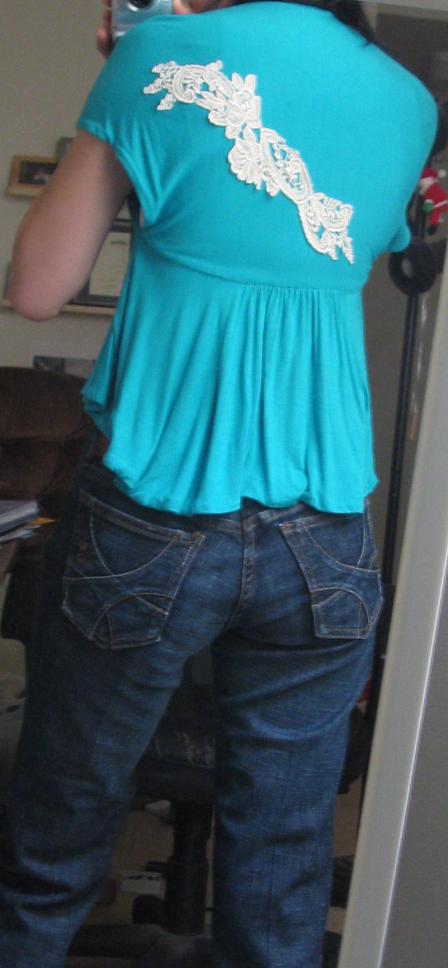
Here's my victim, after it was rescued:

Yes, I said "rescued." I can't believe I almost ruined this lovely new Jak & Rae top, purchased during my last trip Loehmann's (see last post). It wasn't very expensive, which was why I was willing to chance washing by hand (I would never do that with my suits). Still, if I did total it, I wouldn't have been able to buy a replacement. Fortunately, this story has a happy ending, but I'm here to let know what to do to prevent a scare in the first place.

I hand-wash things for a number of reasons. First, people have done it for years before dry cleaning existed. Second, most things won't shrink through contact with cold water, despite the "dry clean only" label. Even if a new piece is machine-washable, I do it in order to prevent brilliant dyes from leaching onto the rest of my laundry (since I have to pay to get laundry done most of the time, I save money by not separating colors). However, reasons #1 and 2 need to be reevaluated. True, people have washed lots of fabrics, even delicate ones, throughout history, but that's before man- and woman-kind were able to invent new fiber materials that don't necessarily conform to the laws of nature. Some of those newfangled fibers will shrink if you wash them.

My top was 100% Rayon. I figured that I've machine-washed some rayon-blend clothes before and they came out fine, so hand-washing should be fine. After I washed it and wrung it, I thought, "Wow, this is really heavy! I guess rayon absorbs tons of water!" I hung it on a drying rack, but I grew impatient at the snail's pace of drying. I tossed it into the dryer when my machine-washed load was done. After I took it out of the dryer, I noticed that the front seemed a bit shorter, shoulders were tighter, and the back seam (where the ruffles were gathered) went up 2 inches! I was understandably aghast.

What I didn't know is that rayon has low wet strength, which means it's highly unstable when wet. Therefore, it is susceptible to shrinkage (as much as 10%) or stretchage (is that even a word?). Some types of rayons (like viscose) were manufactured to have better wet strength than others. Apparently the fibers in my top didn't fall into that group.

Take home lesson #1: read the label to figure out what the fibers are, then do a quick Google search on the properties of those fibers. It might be helpful to sample a few sites, since even expert opinions can vary. I found this site to be simple and informative, and I've included the link so that I can reference it in the future. If I had known about the low wet weight issue, I would have carefully dried my top like I would with cashmere sweaters (with a towel, then lay flat) instead of employing expedient yet detrimental methods. If the fibers are really, really unsuitable for water and/or your piece of clothing costs a lot of money, it's better not to take the risk.

After feeling a bit of outrage, I was determined to unshrink this thing. If the fibers can both shrink and stretch, I was sure that I can stretch it back out. I followed TBF's advice on unshrinking a wool sweater (using lukewarm water and hair conditioner) with a few of my own modifications. After I squeezed out water, the top was really heavy, so I gently tugged at it lengthwise. Then, I used a towel to blot out the excess water. The top was laid flat to dry for a few hours, subjected to a few more gentle stretchings over time. When it was mostly dried but still a little damp, I decided to let gravity do my bidding. The top half of the top was flat on the drying rack, but I pushed the bottom half over the edge so that it hangs free. An hour or two later, I let the top half hang down instead of the bottom. By the next day, my top was back to more or less normal size, as shown in the pictures above.

Take Home Lesson #2: If it shrank, don't panic! Do some online research and act quickly.

I consider myself pretty lucky, since not all mistakes are reversable. On that same day, which I should dub the "unluckiest laundry day ever," my Joie pants also shrunk in the dryer. It's now a good fit and has a better length (which is what I wanted), but unfortunately the outside seams are all bunched up. I'll try to simultaneously iron and stretch later, but I don't know if it's gonna work. I'll let you know when I have time to try it.

1.16.2006

Random Roundup

I've lost an interest in shopping lately, which is great for my wallet. However, that also means I didn't have much inspiration to blog. I should have written these down last week, but what the heck, better late than never:

1) Take advantage of store closing sales at The Limited. To my disappointment, my favorite store location has already closed, and another one I visited last week is doing their final round of closeouts. What a shame--I've long depended on The Limited for their great clearance merchandises, featuring both work- and party-worthy staples. In the past, I've gotten great tops for $5-8 (sometimes $10), cool jewelry for a few bucks, and skirts for under $20. I don't know if they're keeping a few locations open or closing everything, but either way, I won't have access to those stores anymore. I guess I'll still find the merchandise at Ross, but that's about it.

2) Taking good care of your clothes now will save you lots of money in the long run. Right now Le Target can help you accomplish those goals. Even though a lot of things there aren't exactly cheap, I like their limited-time $1 special offers of miscellaneous knicknacks. I guess it's their brick-and-motar version of the Red Hot Shop. When I was there 2 weeks ago, they capitalized on the "get organized" bullet point on many peoples' New Year's Resolutions. There were lots of little jewelry boxes, earring trees, and miscellaneous laundry supplies like coathangers, tie and belt hangers, suit bags, mesh laundry bags, and sweater de-fuzzers (or whatever you call them). All of them were only a dollar each! I hope there's still some left, since I want to get more hangers and door hooks.

For me, "hand wash only" means throw them in a mesh bag and into the washer. The bags keep your clothes from getting entangled with other items (such as jeans) and getting stretched in the process. However, don't get too carried away; use reasonable judgment. If your clothes are really delicate, you're better off to just hand-wash them. The "hand wash only" items I throw into the washer are knits, wovens, and undies. I have no time to hand-wash stuff that I wear regularly, and if they're tough enough to withstand agitation, there's no sense in wasting time on them. Jersey cottons have held up really well when they're washed in this protected way.

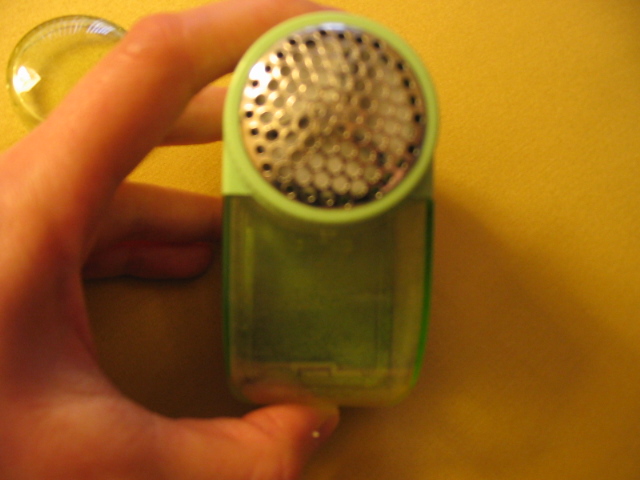
Everyone has favorite sweaters that could have been worn for a little while longer but for the fuzzballs that are all over the surface. De-fuzzing can give them new life. I have a sweatercoat and a really old Express wool sweater that were decimated by pilling, and I was about to just replace them with new stuff. I knew that defuzzers existed, but they are usually found in Asian stores that take effort to get to and I'm a lazy person. I was so happy to see the defuzzers for just a $1 at Target and snatched one up immediately. Operation is simple: just pop in a couple of AA batteries, remove the plastic cap covering the grill, turn it on, and lightly go over the surface. You'll see fuzzballs instantly disappear. As you continue to depill the sweater, the blades will slow down and even stop when fibers wrap around them or get stuck in the center. Remove the grill, use the brushes supplied with the defuzzer to clean it out. Dump out the fuzzballs collected in the clear plastic receptacle. At the end, you'll see a marked before-and-after difference; my sweatercoat looks almost new again, and while my Express sweater didn't recover as miraculously, I'm no longer ashamed to wear it outside of my house.

A couple of caveats with the defuzzer. First, some side effects may occur. It is possible for fibers from perfectly good regions to get snagged, thereby creating a hole in your sweater (this happened with all 3 sweaters, with varing degrees of severity as explained below). Consult your instincts wisely. I see defuzzing as a way to save really old sweaters on the brink of being tossed, so I would strongly advise against using the defuzzer for routine maintenance of newer sweaters. To minimizes the possibility of unwanted holes, keep the defuzzer to the surface instead of pushing it down into the sweater. Second, the defuzzer appears to perform poorly on cotton sweaters. The fibers don't seem to be as strong, so when fibers get snagged, it is much more likely to get holes. Additionally, the fuzzballs on cotton sweaters don't get picked up as cleanly as wool or acrylic fibers.

Risks aside, I think the defuzzer is a really good tool. Although it caused a couple of small holes in my sweatercoat and wool-blend sweater, the holes were small and could be fixed easily. Besides, the benefits of looking like new again greatly outweighs the annoyance of little holes. However, I'm disappointed with what the defuzzer did to my cotton sweater. That's my 2 cents, so do what you will with them.

1.07.2006

To Heck with "Dry Clean Only" (again)

Since I'm broke from Christmas and my wardrobe updates, I ignored the "dry clean only" tags on 4 items (3 of which had been sitting in my laundry tub for a couple of months) and washed them by hand. Now I start to see why designers, via the label, recommend that big dresses made of synthetic fibers should be sent off to the cleaners, but that doesn't mean I'll follow directions. What I had to do was to find a way to deal with the problems created by my stubborness.

The first thing I washed was a dress made with a considerable amount of fairly stiff synthetic fiber fabric (no tags on the composition). Though I can understand why it shouldn't go into the washing machine (the ribbon trim may get destroyed), I saw no reason (e.g., shrinkage) why a dress made from synthetic polymers shouldn't be dunked into water. Into the tub it went. Water turned red--no biggie, the dye comes out from a lot of things. But when I was done, the dress was a beast to handle. It was really heavy! Water clung to the fabric and simply didn't let go even after rigorous wringing. I hung it up on the showerhead to drip dry a little bit, but it became apparent that it wasn't feasible; the dress was so heavy that it might rip the showerhead off, and the shoulders of the dress might get misshapened by the hanger. Since it was too drippy and heavy to move onto my drying rack, I decided to bust out my blowdryer to help shed some of the excess weight. Took about 15 minutes, but it worked! So there you have it--a new use for your blowdryer. People who don't want to deal with the aforementioned hassles may want to take dresses like this to the cleaner, but I'm more willing to put in the time than pulling out my wallet. I think I might use the same procedure to clean my a poofy party dress. However, I will not wash my suits at home because they're just too expensive to risk it.

You may recall that in my post on washing cashmere sweaters, I had a caveat on washing silks. Well, I threw caution out to the wind this time. The next 3 items were silk, and I washed the 2 matching items (top and skirt) at once to save time. In retrospect, that was a mistake--I should have washed the one that can afford to be shrunken first in order to test it out. I used a couple of drops of baby shampoo and very cold water. Back in the day when I was working toward the common good as a techie, I had to do all my protein work in the 4 degree Celsius cold room because the cold keeps the proteins from denaturing. Since silk is a protein, I applied the same principles to prevent shrinkage. The colder the water, the better--other than a few good twirls, your hands won't be in the water for long anyway. When I was done washing, the top was really heavy, and the skirt was worse. For both pieces, I gently squeezed out just enough water so that the top/skirt stops dripping; don't wring because silk chiffon wrinkles very easily. Then, I laid it on a towel for a blot-drying session. The remaining water came out very easily, then I laid it on the rack to air dry. Both pieces dried without incident or wrinkles, and neither shrunk.

Washing the last piece was an interesting experience. It's a 12th Street by Cynthia Vincent long cami/tunic that I got from the FIDM Scholarship Store for $10 yesterday (amazing price and worth breaking my New Year's Resolution for, isn't it?). No problems with shrinkage, but I didn't wash it for long because I saw a lot of glitter coming off. Moral of the story? Pay attention to the embellishments. If the piece is fairly small, really thin, and have no stains, a quick wash and rinse (less than 5 minutes) should get the sweat and dust off without taking off much glitter. However, if the piece is very glitz and glam, pretty sizable and/or if there are big stains, you might be better off to just pony up to the dry cleaning bill. Silks are generally pricey and you want to protect your investments.

10.10.2005

When to ignore the "dry clean only" tag

When I buy clothes, I try to avoid the ones with the "dry clean only" or "hand wash only" tags. Why? As a busy student, I don't have time or money for clothes that are high maintenance. Besides, people have had wools, satins, and chiffons for years before dry cleaning was invented, so there's no reason why we can't continue those traditions now (to a certain extent). However, sometimes getting the "high-maintenance tags" is inevitable, like suits or that pretty sweater that you can't resist. Here are my takes on when to ignore those tags and when not to.

-For cashmere or wool sweaters, you really don't have to take them to the dry cleaners. Follow the TBF guide to washing cashmere sweaters. When I washed my sweaters, I use a modified version of the guide. If you're really concerned about shrinkage, I suggest you put in a little bit of hair conditioner. [For those of you science types, think of it as a Western Blot--wool is protein, lots of disulfide bonds, nonspecific interactions, etc. Just like we would block a blot with nonfat milk to prevent nonspecific binding, we use hair conditioner for washing sweaters. Without going into thermodynamics, let's just say it helps with the renaturing process and leave it at that.] Since I want to make sure the soap is gone, I do a few more "serial dilutions" by pouring out the soapy water, add in fresh water, squeeze out the sweater, and repeat one more time. When it comes to drying, I would use the towel to help blot out some of the water, but I wouldn't keep the sweater to dry on the towel for long. I would put the sweater on top of a drying rack, turning every so often, because a wet towel would only impede the drying process. Having air pass through is better.

-Silks are going to shrink when exposed to water. That happened to one of my silk tops, but I didn't mind because it actually fits me better now. That also happened to my friend's silk top when she accidently got a drop of water on it. Again, silk is protein (alpha helices/beta sheets...I don't even remember anymore). The hair conditioner method might work based on theory, but try it at your own peril.

-For things made of cotton, like one of my twill skirts, dry cleaning is just silly and an obvious waste of money. Get one of those (I don't know what they're called) bags from K-mart or Asian discount stores (I've noticed that places selling Japanese things have them for cheap). They are basically bags made of nets with zippers so that your delicate things won't get tangled up with other clothes. That's what I do with a bulk of things marked "hand wash only" and they are fine. I just have to reshape them a bit when I air-dry them.

And now it's time to state the obvious:

-Leather--everyone knows you don't clean them at home.

-For really expensive coats and suits, it's better to err on the side of caution and take them to the dry cleaners. I wouldn't risk ruining my investments. Sure, "dry clean" stuff could be cleaned with gasoline (remember hearing about that?) because it's another organic solvent like the ones they use at dry cleaning places, but I would rather not chance the embarrassment of having the fire department or hazmat teams come out in case of mishaps. Besides, the wrong solvent can change the color of your garment altogether. Streaks on blazers may look hip, but they won't get you a call-back interview or a job.