
If you've spent too much money lately and wish to cut back, put blinders on and stop staring at this post. Don't let this tempt you. Practice self restraint. Make yourself sick of shopping somehow. Go clean or something.
If you're ready to shop AND in LA, read the text in its entirety below. If you're not from LA, skip to the last paragraph.
--------------------------
There are several sales of note this weekend. One of them is Planet LuLu. Although I've browsed through the online sale and things weren't very appealing to me, their clothes are still heavily discounted. They'll be having their loft sale in Hollywood this Saturday, but it's invite only and invites go out tomorrow. If you're interested, get on their mailing list pronto. I don't know if things will be better than the online selection, but at least you'll get to try them on. I haven't decided if I'll go; there are certain things I need (yes, need, not merely want) to buy, but with rising gas prices, I'm not sure I want to drive out there, struggle with parking, then endure lots of pushing and shoving.
ABS will be having a parking lot sale starting 8am on Saturday. Given what I've been through at the BCBG warehouse sale, I'm not sure I want to struggle again. Besides, my wallet really wants to take it easy. Anyways, for you brave souls out there who are ready to rumble, go to BargainsLA.com for more details. That's how I find out about the good sales in the LA area.
And of course, when stores in the malls near you are welcoming Spring lines, that can only mean one thing: the winter duds have to go. They won't be there long, especially because the prices will be at the lowest points by now, so go now.
1.18.2006

1.16.2006
Random Roundup
I've lost an interest in shopping lately, which is great for my wallet. However, that also means I didn't have much inspiration to blog. I should have written these down last week, but what the heck, better late than never:
1) Take advantage of store closing sales at The Limited. To my disappointment, my favorite store location has already closed, and another one I visited last week is doing their final round of closeouts. What a shame--I've long depended on The Limited for their great clearance merchandises, featuring both work- and party-worthy staples. In the past, I've gotten great tops for $5-8 (sometimes $10), cool jewelry for a few bucks, and skirts for under $20. I don't know if they're keeping a few locations open or closing everything, but either way, I won't have access to those stores anymore. I guess I'll still find the merchandise at Ross, but that's about it.
2) Taking good care of your clothes now will save you lots of money in the long run. Right now Le Target can help you accomplish those goals. Even though a lot of things there aren't exactly cheap, I like their limited-time $1 special offers of miscellaneous knicknacks. I guess it's their brick-and-motar version of the Red Hot Shop. When I was there 2 weeks ago, they capitalized on the "get organized" bullet point on many peoples' New Year's Resolutions. There were lots of little jewelry boxes, earring trees, and miscellaneous laundry supplies like coathangers, tie and belt hangers, suit bags, mesh laundry bags, and sweater de-fuzzers (or whatever you call them). All of them were only a dollar each! I hope there's still some left, since I want to get more hangers and door hooks.
For me, "hand wash only" means throw them in a mesh bag and into the washer. The bags keep your clothes from getting entangled with other items (such as jeans) and getting stretched in the process. However, don't get too carried away; use reasonable judgment. If your clothes are really delicate, you're better off to just hand-wash them. The "hand wash only" items I throw into the washer are knits, wovens, and undies. I have no time to hand-wash stuff that I wear regularly, and if they're tough enough to withstand agitation, there's no sense in wasting time on them. Jersey cottons have held up really well when they're washed in this protected way.


 Everyone has favorite sweaters that could have been worn for a little while longer but for the fuzzballs that are all over the surface. De-fuzzing can give them new life. I have a sweatercoat and a really old Express wool sweater that were decimated by pilling, and I was about to just replace them with new stuff. I knew that defuzzers existed, but they are usually found in Asian stores that take effort to get to and I'm a lazy person. I was so happy to see the defuzzers for just a $1 at Target and snatched one up immediately. Operation is simple: just pop in a couple of AA batteries, remove the plastic cap covering the grill, turn it on, and lightly go over the surface. You'll see fuzzballs instantly disappear. As you continue to depill the sweater, the blades will slow down and even stop when fibers wrap around them or get stuck in the center. Remove the grill, use the brushes supplied with the defuzzer to clean it out. Dump out the fuzzballs collected in the clear plastic receptacle. At the end, you'll see a marked before-and-after difference; my sweatercoat looks almost new again, and while my Express sweater didn't recover as miraculously, I'm no longer ashamed to wear it outside of my house.
A couple of caveats with the defuzzer. First, some side effects may occur. It is possible for fibers from perfectly good regions to get snagged, thereby creating a hole in your sweater (this happened with all 3 sweaters, with varing degrees of severity as explained below). Consult your instincts wisely. I see defuzzing as a way to save really old sweaters on the brink of being tossed, so I would strongly advise against using the defuzzer for routine maintenance of newer sweaters. To minimizes the possibility of unwanted holes, keep the defuzzer to the surface instead of pushing it down into the sweater. Second, the defuzzer appears to perform poorly on cotton sweaters. The fibers don't seem to be as strong, so when fibers get snagged, it is much more likely to get holes. Additionally, the fuzzballs on cotton sweaters don't get picked up as cleanly as wool or acrylic fibers.
Risks aside, I think the defuzzer is a really good tool. Although it caused a couple of small holes in my sweatercoat and wool-blend sweater, the holes were small and could be fixed easily. Besides, the benefits of looking like new again greatly outweighs the annoyance of little holes. However, I'm disappointed with what the defuzzer did to my cotton sweater. That's my 2 cents, so do what you will with them.
1) Take advantage of store closing sales at The Limited. To my disappointment, my favorite store location has already closed, and another one I visited last week is doing their final round of closeouts. What a shame--I've long depended on The Limited for their great clearance merchandises, featuring both work- and party-worthy staples. In the past, I've gotten great tops for $5-8 (sometimes $10), cool jewelry for a few bucks, and skirts for under $20. I don't know if they're keeping a few locations open or closing everything, but either way, I won't have access to those stores anymore. I guess I'll still find the merchandise at Ross, but that's about it.
2) Taking good care of your clothes now will save you lots of money in the long run. Right now Le Target can help you accomplish those goals. Even though a lot of things there aren't exactly cheap, I like their limited-time $1 special offers of miscellaneous knicknacks. I guess it's their brick-and-motar version of the Red Hot Shop. When I was there 2 weeks ago, they capitalized on the "get organized" bullet point on many peoples' New Year's Resolutions. There were lots of little jewelry boxes, earring trees, and miscellaneous laundry supplies like coathangers, tie and belt hangers, suit bags, mesh laundry bags, and sweater de-fuzzers (or whatever you call them). All of them were only a dollar each! I hope there's still some left, since I want to get more hangers and door hooks.
For me, "hand wash only" means throw them in a mesh bag and into the washer. The bags keep your clothes from getting entangled with other items (such as jeans) and getting stretched in the process. However, don't get too carried away; use reasonable judgment. If your clothes are really delicate, you're better off to just hand-wash them. The "hand wash only" items I throw into the washer are knits, wovens, and undies. I have no time to hand-wash stuff that I wear regularly, and if they're tough enough to withstand agitation, there's no sense in wasting time on them. Jersey cottons have held up really well when they're washed in this protected way.

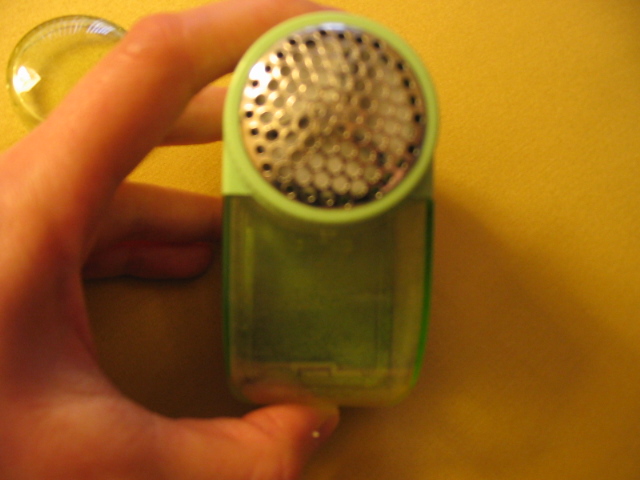
 Everyone has favorite sweaters that could have been worn for a little while longer but for the fuzzballs that are all over the surface. De-fuzzing can give them new life. I have a sweatercoat and a really old Express wool sweater that were decimated by pilling, and I was about to just replace them with new stuff. I knew that defuzzers existed, but they are usually found in Asian stores that take effort to get to and I'm a lazy person. I was so happy to see the defuzzers for just a $1 at Target and snatched one up immediately. Operation is simple: just pop in a couple of AA batteries, remove the plastic cap covering the grill, turn it on, and lightly go over the surface. You'll see fuzzballs instantly disappear. As you continue to depill the sweater, the blades will slow down and even stop when fibers wrap around them or get stuck in the center. Remove the grill, use the brushes supplied with the defuzzer to clean it out. Dump out the fuzzballs collected in the clear plastic receptacle. At the end, you'll see a marked before-and-after difference; my sweatercoat looks almost new again, and while my Express sweater didn't recover as miraculously, I'm no longer ashamed to wear it outside of my house.
A couple of caveats with the defuzzer. First, some side effects may occur. It is possible for fibers from perfectly good regions to get snagged, thereby creating a hole in your sweater (this happened with all 3 sweaters, with varing degrees of severity as explained below). Consult your instincts wisely. I see defuzzing as a way to save really old sweaters on the brink of being tossed, so I would strongly advise against using the defuzzer for routine maintenance of newer sweaters. To minimizes the possibility of unwanted holes, keep the defuzzer to the surface instead of pushing it down into the sweater. Second, the defuzzer appears to perform poorly on cotton sweaters. The fibers don't seem to be as strong, so when fibers get snagged, it is much more likely to get holes. Additionally, the fuzzballs on cotton sweaters don't get picked up as cleanly as wool or acrylic fibers.
Risks aside, I think the defuzzer is a really good tool. Although it caused a couple of small holes in my sweatercoat and wool-blend sweater, the holes were small and could be fixed easily. Besides, the benefits of looking like new again greatly outweighs the annoyance of little holes. However, I'm disappointed with what the defuzzer did to my cotton sweater. That's my 2 cents, so do what you will with them.
1.07.2006
To Heck with "Dry Clean Only" (again)
Since I'm broke from Christmas and my wardrobe updates, I ignored the "dry clean only" tags on 4 items (3 of which had been sitting in my laundry tub for a couple of months) and washed them by hand. Now I start to see why designers, via the label, recommend that big dresses made of synthetic fibers should be sent off to the cleaners, but that doesn't mean I'll follow directions. What I had to do was to find a way to deal with the problems created by my stubborness.
The first thing I washed was a dress made with a considerable amount of fairly stiff synthetic fiber fabric (no tags on the composition). Though I can understand why it shouldn't go into the washing machine (the ribbon trim may get destroyed), I saw no reason (e.g., shrinkage) why a dress made from synthetic polymers shouldn't be dunked into water. Into the tub it went. Water turned red--no biggie, the dye comes out from a lot of things. But when I was done, the dress was a beast to handle. It was really heavy! Water clung to the fabric and simply didn't let go even after rigorous wringing. I hung it up on the showerhead to drip dry a little bit, but it became apparent that it wasn't feasible; the dress was so heavy that it might rip the showerhead off, and the shoulders of the dress might get misshapened by the hanger. Since it was too drippy and heavy to move onto my drying rack, I decided to bust out my blowdryer to help shed some of the excess weight. Took about 15 minutes, but it worked! So there you have it--a new use for your blowdryer. People who don't want to deal with the aforementioned hassles may want to take dresses like this to the cleaner, but I'm more willing to put in the time than pulling out my wallet. I think I might use the same procedure to clean my a poofy party dress. However, I will not wash my suits at home because they're just too expensive to risk it.
You may recall that in my post on washing cashmere sweaters, I had a caveat on washing silks. Well, I threw caution out to the wind this time. The next 3 items were silk, and I washed the 2 matching items (top and skirt) at once to save time. In retrospect, that was a mistake--I should have washed the one that can afford to be shrunken first in order to test it out. I used a couple of drops of baby shampoo and very cold water. Back in the day when I was working toward the common good as a techie, I had to do all my protein work in the 4 degree Celsius cold room because the cold keeps the proteins from denaturing. Since silk is a protein, I applied the same principles to prevent shrinkage. The colder the water, the better--other than a few good twirls, your hands won't be in the water for long anyway. When I was done washing, the top was really heavy, and the skirt was worse. For both pieces, I gently squeezed out just enough water so that the top/skirt stops dripping; don't wring because silk chiffon wrinkles very easily. Then, I laid it on a towel for a blot-drying session. The remaining water came out very easily, then I laid it on the rack to air dry. Both pieces dried without incident or wrinkles, and neither shrunk.
Washing the last piece was an interesting experience. It's a 12th Street by Cynthia Vincent long cami/tunic that I got from the FIDM Scholarship Store for $10 yesterday (amazing price and worth breaking my New Year's Resolution for, isn't it?). No problems with shrinkage, but I didn't wash it for long because I saw a lot of glitter coming off. Moral of the story? Pay attention to the embellishments. If the piece is fairly small, really thin, and have no stains, a quick wash and rinse (less than 5 minutes) should get the sweat and dust off without taking off much glitter. However, if the piece is very glitz and glam, pretty sizable and/or if there are big stains, you might be better off to just pony up to the dry cleaning bill. Silks are generally pricey and you want to protect your investments.
The first thing I washed was a dress made with a considerable amount of fairly stiff synthetic fiber fabric (no tags on the composition). Though I can understand why it shouldn't go into the washing machine (the ribbon trim may get destroyed), I saw no reason (e.g., shrinkage) why a dress made from synthetic polymers shouldn't be dunked into water. Into the tub it went. Water turned red--no biggie, the dye comes out from a lot of things. But when I was done, the dress was a beast to handle. It was really heavy! Water clung to the fabric and simply didn't let go even after rigorous wringing. I hung it up on the showerhead to drip dry a little bit, but it became apparent that it wasn't feasible; the dress was so heavy that it might rip the showerhead off, and the shoulders of the dress might get misshapened by the hanger. Since it was too drippy and heavy to move onto my drying rack, I decided to bust out my blowdryer to help shed some of the excess weight. Took about 15 minutes, but it worked! So there you have it--a new use for your blowdryer. People who don't want to deal with the aforementioned hassles may want to take dresses like this to the cleaner, but I'm more willing to put in the time than pulling out my wallet. I think I might use the same procedure to clean my a poofy party dress. However, I will not wash my suits at home because they're just too expensive to risk it.
You may recall that in my post on washing cashmere sweaters, I had a caveat on washing silks. Well, I threw caution out to the wind this time. The next 3 items were silk, and I washed the 2 matching items (top and skirt) at once to save time. In retrospect, that was a mistake--I should have washed the one that can afford to be shrunken first in order to test it out. I used a couple of drops of baby shampoo and very cold water. Back in the day when I was working toward the common good as a techie, I had to do all my protein work in the 4 degree Celsius cold room because the cold keeps the proteins from denaturing. Since silk is a protein, I applied the same principles to prevent shrinkage. The colder the water, the better--other than a few good twirls, your hands won't be in the water for long anyway. When I was done washing, the top was really heavy, and the skirt was worse. For both pieces, I gently squeezed out just enough water so that the top/skirt stops dripping; don't wring because silk chiffon wrinkles very easily. Then, I laid it on a towel for a blot-drying session. The remaining water came out very easily, then I laid it on the rack to air dry. Both pieces dried without incident or wrinkles, and neither shrunk.
Washing the last piece was an interesting experience. It's a 12th Street by Cynthia Vincent long cami/tunic that I got from the FIDM Scholarship Store for $10 yesterday (amazing price and worth breaking my New Year's Resolution for, isn't it?). No problems with shrinkage, but I didn't wash it for long because I saw a lot of glitter coming off. Moral of the story? Pay attention to the embellishments. If the piece is fairly small, really thin, and have no stains, a quick wash and rinse (less than 5 minutes) should get the sweat and dust off without taking off much glitter. However, if the piece is very glitz and glam, pretty sizable and/or if there are big stains, you might be better off to just pony up to the dry cleaning bill. Silks are generally pricey and you want to protect your investments.
1.06.2006
Learning to Haggle
Although I've been really good at scoring inexpensive goodies, I must confess that I'm a beginner when it comes to haggling. Why? As a veteran attacker of retail store clearance racks, I haven't had the need or opportunity to haggle much. There's not much room for haggling when it comes to retail chains unless it's a damaged piece, and the prices are often so low that there's really no reason to haggle. However, that all changed in the past 6 months. When I started shopping at sample sales, I learned that prices are negotiable. When I had to buy a second-hand fridge that was cheap but was definitely not in great shape, I had to talk down the price.
Even when the need and opportunity to haggle arose, I was a bit hesitant. My parents do it all the time and have no qualms about it, but I was held back by a false sense of propriety or decorum, if you will. Somehow I felt embarassed about challenging the price--I was afraid that I'll be bad at it, ask for too low a price, and be laughed off the block. Other times I'd think of haggling as somewhat "declasse," in the sense that it makes a person come across as being really cheap in a really bad way, like someone who is ignorant about "the system" of non-negotiable retail. I came to realize that I was being silly. There's nothing wrong with haggling--the worse that could happen is that your offer is rejected and you'd have to pay for the listed price, and there's nothing "declasse" about it, since businesspeople do it all the time.
My first steps to haggling were small, started with slightly damaged merchandise. I got this one plush stool from Ross, which is composed of 4 legs and a seat shaped as the face of a cat. I really liked it, though it was more expensive than I'd like and had a messed-up whisker (which was sewn into the seat). I knew that I can take out the threads and sew in new whiskers fairly easily, so I decided to ask for a discount. I expected 10%, maybe 15%, but I ended up getting 20%. That really left a mark on how I shop. Of course I'd avoid damaged merchandise when at all possible, but if I'm buying stuff for myself but it's the last one (in my size) and I can't find an undamaged counterpart, I'd go the damaged merchandise discount route. I'm willing to buy clothes with small holes along the seams, but I'm not willing to buy knits with snags or anything with stains. Snags are hard to fix by yourself, or you'd have to pay someone to do it, with no guarantees that it'll look presentable upon repair. As for stains--you don't know what it is (ick) or how hard it will be to remove them.
When I moved on to sample sales, I observed a few things: salespersons are willing to haggle when you reach the $30 mark, if you're nice to them, if you're paying with cash, and if you ask for a reasonable percentage compensurate with how much you're buying. If you're unsure how to proceed beyond the realm of damaged goods, just pay attention to how other people do it. That's how I learned.
-Based on my experiences, people are not willing to lower the price until you hit $30. If you're close, like $28, try to shoot for $25. However, it's not a hard-and-fast rule, especially if all the merchandise is pricier than $30. If you're hitting a ritzier place, you may need to adjust slightly upwards.
-When you're paying cash, sometimes it's hard to give you change. If you're able to offer a nice round number whereupon salespeople won't have to hassle with counting cash, they're more inclined to go with your offer.
-What I meant by a "reasonable percentage" is this: if you're spending $30, don't expect to get $10 off. The less you spend, the less you can get taken off, so if you do spend $30, expect no more than a dollar or 2. The higher you go, the more you can ask for--if you're buying a $50 pair of jeans, you can try to get $45, and so on.
-If you aren't spending that much money, you can still flex your bargaining muscles at checkout. If you've treated the staff with respect while your were rummaging through the sales racks, you might be able to round down to the nearest $5. Additionally, even if most pieces are expensive to begin with and you only bought the cheapest stuff, multiple cheap things = illusion of buying lots ("collective barganing" can be a powerful thing). Both of those factors helped me out at a sale I went to recently. Most items of clothing on "sale" were $40. My total was $43 but was composed of things that were under $20. Instead of haggling on individual pieces, which by all accounts were already "cheap," I waited until the grand total before asking "can we do $40?" Yes, that's the lingua franca of bargaining. Repeat after me: Can we do (fill in the blank)? Very quick, easy, and casual. If they say no, all you have to do is say "that's fine" or "I don't think I'll take it." Who knows? Sometimes you putting stuff down might get them to say "OK, let's do (your amount here)."
-A corollary to the last point: if you're buying a single "big-ticket" item along with a few cheap things, it's probably better to get a reduction on that big-ticket purchase than an overall reduction. It won't make you look cheap because you're trying to get a discount on just one thing, and besides, it won't be likely for you to get a much bigger discount for the little things anyway. Conversely, if you're buying cheap stuff, use the "collective bargaining" method above.
Most recently, my fridge crapped out right before Finals (yes, lucky me, again. Last year it was my car). Since me and my roommate are students, we don't have much money. Most used fridges on Craig's List were $150 and up, and we certainly couldn't afford to get a new one (at least $400). When we saw a listing for $50, I dropped all my plans and went to see it the next day with my roommate, even though we knew that something must be up. Something was up all right, namely the contents of my stomach. The fridge was older than the one that just broke down, and had its own self-contained ecosystem. There were dead flies and green stuff and yellow stuff everywhere. I couldn't believe that people had put food in that thing. I was about to turn away when the seller offered to let us clean the inside with a hose. Well, as long as I don't have to deal with the grossness at home in a small, confined space, I'm OK with that. The seller ended up doing a lot of the cleaning and offered supplies for us to scrub out concentrated spots of nastiness. Before we got down to the serious cleaning, I asked the seller if we can do $40 and he readily agreed. Even though it was really not worth $40, I didn't go lower because he was so nice in helping us clean. So, kindness really cuts both ways in the transaction. It would have been unreasonable to ask for a further reduction after what he did for us. However, this anecdote also illustrates what we've known all along: the asking price is always higher than what the seller aims to get because sellers expect haggling to take place. If you don't haggle, the seller gets a windfall.
That's it for now, folks!
Even when the need and opportunity to haggle arose, I was a bit hesitant. My parents do it all the time and have no qualms about it, but I was held back by a false sense of propriety or decorum, if you will. Somehow I felt embarassed about challenging the price--I was afraid that I'll be bad at it, ask for too low a price, and be laughed off the block. Other times I'd think of haggling as somewhat "declasse," in the sense that it makes a person come across as being really cheap in a really bad way, like someone who is ignorant about "the system" of non-negotiable retail. I came to realize that I was being silly. There's nothing wrong with haggling--the worse that could happen is that your offer is rejected and you'd have to pay for the listed price, and there's nothing "declasse" about it, since businesspeople do it all the time.
My first steps to haggling were small, started with slightly damaged merchandise. I got this one plush stool from Ross, which is composed of 4 legs and a seat shaped as the face of a cat. I really liked it, though it was more expensive than I'd like and had a messed-up whisker (which was sewn into the seat). I knew that I can take out the threads and sew in new whiskers fairly easily, so I decided to ask for a discount. I expected 10%, maybe 15%, but I ended up getting 20%. That really left a mark on how I shop. Of course I'd avoid damaged merchandise when at all possible, but if I'm buying stuff for myself but it's the last one (in my size) and I can't find an undamaged counterpart, I'd go the damaged merchandise discount route. I'm willing to buy clothes with small holes along the seams, but I'm not willing to buy knits with snags or anything with stains. Snags are hard to fix by yourself, or you'd have to pay someone to do it, with no guarantees that it'll look presentable upon repair. As for stains--you don't know what it is (ick) or how hard it will be to remove them.
When I moved on to sample sales, I observed a few things: salespersons are willing to haggle when you reach the $30 mark, if you're nice to them, if you're paying with cash, and if you ask for a reasonable percentage compensurate with how much you're buying. If you're unsure how to proceed beyond the realm of damaged goods, just pay attention to how other people do it. That's how I learned.
-Based on my experiences, people are not willing to lower the price until you hit $30. If you're close, like $28, try to shoot for $25. However, it's not a hard-and-fast rule, especially if all the merchandise is pricier than $30. If you're hitting a ritzier place, you may need to adjust slightly upwards.
-When you're paying cash, sometimes it's hard to give you change. If you're able to offer a nice round number whereupon salespeople won't have to hassle with counting cash, they're more inclined to go with your offer.
-What I meant by a "reasonable percentage" is this: if you're spending $30, don't expect to get $10 off. The less you spend, the less you can get taken off, so if you do spend $30, expect no more than a dollar or 2. The higher you go, the more you can ask for--if you're buying a $50 pair of jeans, you can try to get $45, and so on.
-If you aren't spending that much money, you can still flex your bargaining muscles at checkout. If you've treated the staff with respect while your were rummaging through the sales racks, you might be able to round down to the nearest $5. Additionally, even if most pieces are expensive to begin with and you only bought the cheapest stuff, multiple cheap things = illusion of buying lots ("collective barganing" can be a powerful thing). Both of those factors helped me out at a sale I went to recently. Most items of clothing on "sale" were $40. My total was $43 but was composed of things that were under $20. Instead of haggling on individual pieces, which by all accounts were already "cheap," I waited until the grand total before asking "can we do $40?" Yes, that's the lingua franca of bargaining. Repeat after me: Can we do (fill in the blank)? Very quick, easy, and casual. If they say no, all you have to do is say "that's fine" or "I don't think I'll take it." Who knows? Sometimes you putting stuff down might get them to say "OK, let's do (your amount here)."
-A corollary to the last point: if you're buying a single "big-ticket" item along with a few cheap things, it's probably better to get a reduction on that big-ticket purchase than an overall reduction. It won't make you look cheap because you're trying to get a discount on just one thing, and besides, it won't be likely for you to get a much bigger discount for the little things anyway. Conversely, if you're buying cheap stuff, use the "collective bargaining" method above.
Most recently, my fridge crapped out right before Finals (yes, lucky me, again. Last year it was my car). Since me and my roommate are students, we don't have much money. Most used fridges on Craig's List were $150 and up, and we certainly couldn't afford to get a new one (at least $400). When we saw a listing for $50, I dropped all my plans and went to see it the next day with my roommate, even though we knew that something must be up. Something was up all right, namely the contents of my stomach. The fridge was older than the one that just broke down, and had its own self-contained ecosystem. There were dead flies and green stuff and yellow stuff everywhere. I couldn't believe that people had put food in that thing. I was about to turn away when the seller offered to let us clean the inside with a hose. Well, as long as I don't have to deal with the grossness at home in a small, confined space, I'm OK with that. The seller ended up doing a lot of the cleaning and offered supplies for us to scrub out concentrated spots of nastiness. Before we got down to the serious cleaning, I asked the seller if we can do $40 and he readily agreed. Even though it was really not worth $40, I didn't go lower because he was so nice in helping us clean. So, kindness really cuts both ways in the transaction. It would have been unreasonable to ask for a further reduction after what he did for us. However, this anecdote also illustrates what we've known all along: the asking price is always higher than what the seller aims to get because sellers expect haggling to take place. If you don't haggle, the seller gets a windfall.
That's it for now, folks!
Subscribe to:
Posts (Atom)
 visitors since July 2006, plus a handful more before that